


Innovation: what a word! It’s spoken often, but do we truly understand it, support it and utilize its outcomes?
These are essential questions for executives who are leading companies and looking for that competitive edge. So we use the word innovation quite readily when discussing how to be more competitive, achieve greater market share or drive opportunity.
Based on decades of research, the InnovatorMindset® profile looks at two types of cycles to define true innovation versus what most business leaders actually do.
Most of us tend to adopt the Status Quo Cycle, which has four phases:
- Idea Phase: We ask, “How do we reproduce existing possibilities?” We aren’t seeking new or outside information, but simple sustainability of the existing known outcomes. Our focus tends to be on that which is proven, what we already know and have used.
- Feedback Phase: We look for reinforcement of what has worked in the past and why it worked. We restore our world to what has been and try to maintain the status quo.
- Reality Phase: We detect deviations in the present system or process that could cause a different or lesser outcome. Our focus is then on correction of the deviation to return to the normal or existing.
- Action Phase: In this corrective phase, we apply the solutions we are familiar with or have previously used in order to eliminate the deviations and return to the norm.

In the Status Quo Cycle, the focus is on utilizing the known and existing solutions to maintain the existing norm. Often times this referred to as “detect and correct”, which is vital to a sound and functioning business operation. We do not want to eliminate or avoid this cycle, but simply be aware of which cycle we are in.
In comparison, the Innovation Cycle seeks new information and explores what is not yet known, in four phases.
- The Reality Phase: We observe our business surroundings and our environment, and become aware of what is or is not happening. We see consequences that might not have been noted before and outcomes that we were not aware of. We look for the new or different versus the known and established.
- Feedback Phase: The new information or insight is interpreted. We seek to learn new knowledge, discover various applications and retain that which has possible value.
- Idea Phase: The new knowledge and insights lead to new ideas or applications that have not been applied before. We strive for new possibilities that existing knowledge has not given us.
- Action Phase: We take action by experimenting and undergoing trial and error. We apply the new knowledge and insights to observe what positive or negative outcomes may occur, testing our new hypothesis. This might be referred to as “failing forward:” testing quickly and adjusting to determine the best new solution or opportunity.
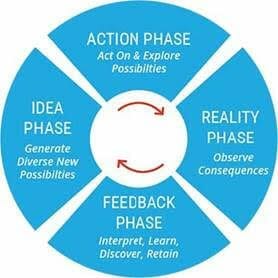
You’ll note a significant difference in mindset between the two cycles. The Status Quo is focused on tried, true processes and knowledge to maintain an existing situation, while the Innovator Cycle is all about seeing the existing differently, actively seeking new information and encouraging experimentation to try something new and different.
So what are we suggesting?
First, in which cycle does your organization invest most of its time and energy? Most are in the Status Quo, and occasionally a few within the organization might utilize the Innovation Cycle. What we recommend, and what highly innovative organizations do, is elevate the Innovation Cycle to a higher status, encouraging it through experimentation and working to stay out of Status Quo cycle.
On the flip side, the Status Quo is important, and while only utilizing the Innovation Cycle might be exciting, it’s not stable enough for long term growth and profitability. Both need to be utilized with purpose.
Are you including innovation as an initiative in your strategic planning? If not, perhaps that is a place to start.
Watch for our next post on utilizing the Innovation Cycle as a leadership communication tool.
For more on the InnovatorMindset® contact H. Goerger & Associates Inc. dba AskHG, one of the first to be certified in the nation.
InnovatorMindset® is the property of Dennis Stauffer, www.InnovatorMindset.com
