

The Importance of One-to-One Meetings

Picture of a table and chairs and text overlay "using one to ones to improve company culture"

In a time when mass resignations and job dissatisfaction are on the rise, leading one-to-one meetings with your team members is a great way to build an environment of loyalty. Showing your employees you value their input by giving them your time and attention can help ensure they remain dedicated to the success of your business.

One-to-ones are widely acknowledged as a powerful tool for building relationships, increasing morale, and boosting productivity. However, these meetings are often the first casualty of a leader’s busy schedule.

For leaders ready to nurture happier and more productive working relationships, we’ve laid out what you can do to make one-to-ones a non-negotiable priority.

What Is a One-To-One?

At their core, one-to-ones are simply dedicated time for employees to meet with their manager without other teammates present. Many leaders use one-to-ones to focus on the employee’s overall development and discuss issues the manager may not be aware of. However, one-to-one meetings serve more purposes than just goal setting and goal tracking; leaders can also use them to ensure all team members are aware of information pertinent to their jobs.

Communicating important information via large team meetings or in passing around the office saves time in the short term, but it doesn’t allow for larger conversations. Your employees likely have their own concerns and questions, and they may not want to share those in a group setting. A one-to-one gives your workers the privacy to discuss their thoughts while also offering you valuable insight into your company’s culture and your employees’ wellbeing.
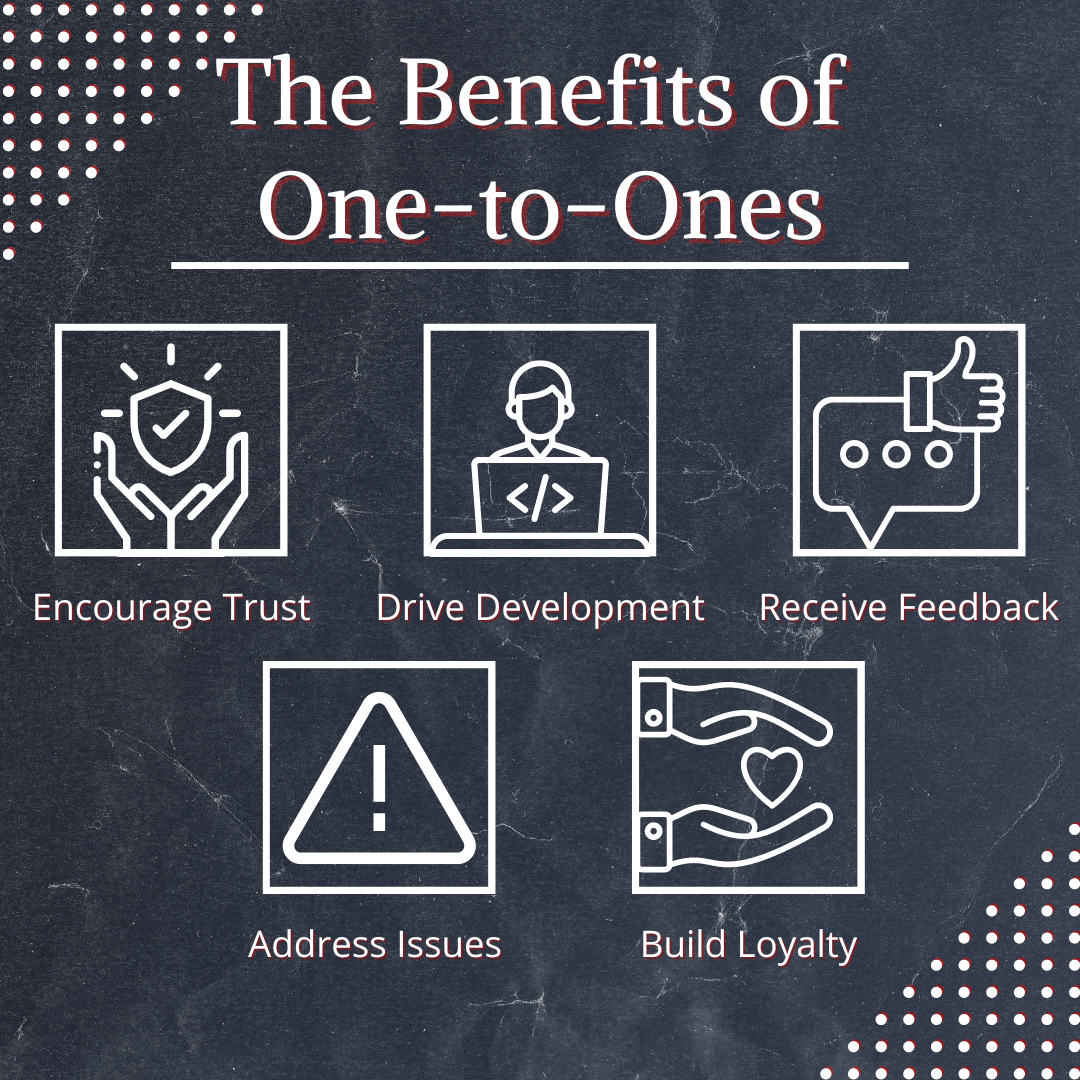
The benefits of one-to-ones

How Do One-To-Ones Help Employees?

During one-to-ones, employees can have a personal, private conversation with the person who will be most involved in their professional development—their manager. These meetings can help employees better understand their role in the company, what is expected of them, and how they can improve their performance. They can also be used to help your employees plan for their futures within the company—how do they want to advance and grow?

Additionally, one-to-one meetings help employees feel heard, something that remains important no matter how large your company grows. A dedicated time to share thoughts and ideas shows employees their input is valued and their feedback is appreciated. Happy workers are more productive—when employees are treated respectfully and fairly by their superiors, they’re likely to be more engaged and perform at a level that benefits the entire company.

How Do One-To-One Meetings Help Leaders?

One-to-ones aren’t just for the benefit of employees; leaders must also understand that one-to-ones are an essential tool for their overall success. One-to-one meetings are an opportunity for leaders to learn more about their employees. Asking questions about their motivations, their challenges, and whether they need more support to do their job can eliminate small issues before they become more disruptive.

Employee one-to-ones are also a chance for managers to understand how they can support their employees and inspire them to do their best work. Having these meetings regularly builds trust, and this trust empowers both parties to speak up when changes need to be made.

A Guide to Great One-To-Ones

One-to-ones are often less structured than formal meetings and treated as more of an open discussion about what the manager and employee need from each other. However, one-to-one meetings still require preparation to ensure they’re a productive use of time. No one likes meetings that could have been an email!

Set an Agenda

Before leading your one-to-ones, set a loose agenda. Consider the questions that need answers and the topics of conversation you can use to clarify your employees’ needs. The aim of your one-to-one will differ from employee to employee, but topics of discussion may include:

  • Professional development goals: how do they envision the trajectory of their career? Do they need additional resources to learn a new skill?
  • Feedback exchange: what can they improve upon? How can you better serve them as a leader?
  • Emotional wellbeing: how have they been doing? What roadblocks or stressors are they experiencing?
  • New employee check-in: how has their first week or month gone? From a first impression, where do they see the need for improvement within the company?
  • Employee thoughts: do they have any issues, concerns, or questions? Do they need clarification, have a new idea, or have valuable insight to share?

At CEO Solutions, many of our clients find one-to-one meetings most useful when the employee’s agenda is the top priority. This allows you, as a business leader, to get the employee’s organic thoughts, as well as a great sense of “what’s really happening” in your organization.

Review Relevant Information

You should also prepare for one-to-one meetings by reviewing notes from previous meetings. Refresh yourself on important topics, like career goals, work assignments, or performance issues.

Be Transparent

Since your employees might be nervous about these meetings, it’s essential to be transparent. As a manager, you have the opportunity to set an example for your team by being honest and open about your feelings and perspectives. Your openness will help foster trust because employees know they can be honest with you without fear of judgment or consequences.

Improving Company Culture with CEO Solutions

There’s no denying it: one-to-one meetings create a culture of feedback and trust. When employees know their opinions are valued, they’re more engaged in their work and more likely to stay with a company long-term.

CEO Solutions clients are constantly reminded that happy and effective employees know three things:

  1. The specific expectations of their role
  2. That they’ll often get to work to their strengths and passions
  3. That their company cares about them

One-to-ones help confirm these truths.

And while one-to-ones are not a perfect fix for low employee morale, if used correctly, they are an incredibly useful tool in the workplace. Consider implementing regular one-to-one meetings with your team members to see how effective they can be—and reap the rewards that follow.

CEO Solutions provides peer-to-peer business owner and leader meetings to help you tackle issues and opportunities within your company. CEO Solutions also meets with our group members in a one-on-one meeting every month to focus specifically on their development. Whether you’re struggling to build a culture of loyalty or seeking professional development for your second-in-command, our peer groups can help. Meet with other owners who have faced—or are currently facing—similar issues and learn the tactics you need to grow a successful, scalable business. Become a member of CEO Solutions today, or visit our website to learn more.

Why Communication is Important for Successful Leadership

a red lock with three wooden people

Learning Communication from a Leadership Perspective

There are a few business skills that everyone needs. But effective communication is just one of the skills that set apart leaders. Learning leadership from a communication perspective is often a crucial step in any person’s success.

Becoming the Masters in Communication and Leadership
Masters in communication and leadership strive to build a successful foundation for their clients and workers. With that in mind, first we should outline what that foundation looks like.

Building the Foundation
Any good communicator is born out of a good communication plan. The first step in your plan should be building an excellent foundation. To do this, we should identify a few rules to establish a baseline for interaction with your peers.

Good communication should never be one-sided. The best communicators regulate the flow of conversation to make sure all sides are represented in the discussion. If you feel that someone’s voice is underrepresented, make sure to steer the conversation in their direction. You should also make sure that, during communication efforts, you take the necessary steps to minimize interruption and distraction.

Why Good Communication Skills are Important
The word ‘communication’ itself is used constantly. But have you ever stopped to ask why? Buzzwords can often be overused, but this one has proven to be an exception to the rule. These reasons are proof that communication deserves all the hype.

First, teams thrive on communication. Any breakdowns occurring in your business can cause loss of time and resources, cost your business, and even radically alter production timelines.

Second, any great leader should recognize that communication happens in all forms. To improve your relationships with your team, you’ll need to learn how to read each medium. During your next performance self-assessment, you should gauge your ability to read things like body language, gestures, tone, and inflection. Also, make sure to touch up on how people communicate digitally, given the ever-changing landscape of the modern office.

Common Mistakes
As you’re learning leadership from a communication perspective, you may want to avoid three common mistakes during interactions.

• Language: Make sure that you are using language effectively. You’ve heard that the pen is mightier than the sword, but we assert that your voice is leaps and bounds more effective than both. When addressing your peers, make sure that you are careful and deliberate with your words
• Tone: We’ve all been in a situation where a negative tone has been levied our way. We encourage masters in communication and leadership to keep a positive tone. This way any interaction you have is not upsetting for anyone involved. Instead, you are a well-oiled machine simply working out a few rusty gears.
• Listening to Respond: The next time you are about to respond to someone, stop and ask yourself if you’ve really thought through what they just said. It’s easy to catch yourself simply listening to respond instead of doing what you’re supposed to be doing: communicating. Take a little extra time to parse out what someone is saying, so you can have an appropriate and productive response.

The Next Steps in Your Leadership Communication Plan

You’re on the road to becoming a better leader. Now there are just a few more things we encourage you to work on soon.

For one, learn to adapt your style to the situation and group surrounding you. this will play a key part in making sure that no hiccups in communication occur. Next, be sure to emphasize and improve your listening. No one will mind if you take a few extra minutes to really think about what’s being said. If anything, they’ll respect you more for taking matters seriously. Finally, learn to empathize and understand the mindset of your teams. A great leader not only listens, but also understands where the speaker is coming from and what emotions they are feeling.

With these tips, you can’t go wrong and are on the fast track to becoming the best version of yourself.

Business Skills That Set Successful CEOs Apart

Leadership concept with a red paper ship leading among yellow ships

Becoming a successful CEO or business leader is about much more than having the right pedigree, charisma, or bank account for the job. The skills that set potential leaders apart are difficult to master. In fact, many CEOs that are forced to retire are not pushed out due to failing performance, but by their chosen leadership style.

As a company leader, there are many skills that CEOs must possess to remain successful. Let’s take a look at a few of those skills below:

Embracing Adaptation
As the leader of a team, you must be able to change the rules and adapt to situations consistently. CEOs who are good at adapting their business needs understand that the bigger picture is critical and that setbacks are a part of change. Being comfortable at adapting to change means accepting failures as a learning opportunity, as opposed to defensive responses, blame, and demotivation. Proactive adaptation is not only the sign of a good leader, but a skill set any company will need to stay successful.

Taking Decisive Action
Any successful CEO must be quick to make decisions. This does not mean they are rash or impetuous, but that they can make decisions with conviction and timeliness. It also means that they are not afraid to make the wrong decision, and can still come to a conclusion with limited scope or incomplete information. Leaders are not expected to make the perfect decision every time, but good leaders stand out in the ability to avoid doubt and come to a conclusion.

In an article for the Harvard Business Review, global managing partner of McKinsey & Company Dominic Barton says, “As a CEO you are constantly faced with situations where a playbook simply cannot exist. You’d better be ready to adapt.”

Reliability
Perhaps an obvious answer, leaders must remain consistent. Setting realistic expectations upfront, a good leader delivers predictable and steady results time after time. to accomplish this, CEOs need to possess considerable organizational and planning skills. A CEO’s time might be spread among various tasks, so tackling them time after time while delivering consistent results is very important. often, this is done most successfully by constructing a leadership team of talented and dedicated employees.

Preparation for the Future
CEOs need to be forward-thinkers. As we have all come to understand in a post-pandemic workplace, what is working for an organization may not work in the future. Good leaders identify potential problems in their organization and address them as soon as they arise. They also engage with their stakeholders to gain support for their future goals.

CEO Solutions is a group dedicated to helping leaders develop their skills by connecting with their peers. We want to help area leaders grow their skills and develop successful businesses. Contact CEO Solutions to learn more.

The Benefits of Professional Development Opportunities for Employees

Two women working in a professional environment

Recognizing and addressing skills gaps are hot topics in any professional industry. Most businesses understand that waiting for the perfect employee to come along that checks all the boxes they might want for a position is not always realistic. Other businesses would rather train an existing employee and promote from within than risk the responsibilities of a management role on an outside hire.

Professional development can come in many forms. Some might include off-site workshops or classes, professional memberships, or even tuition reimbursement programs. The goal of a professional development program within an organization is to increase the skills of existing employees and show that the company is invested in their development. Professional development opportunities also improve company morale and help build trust and loyalty.

Increase Retention
According to Career Builder, the average company loses more than $14,000 for every job that says vacant longer than three months. While many companies are cutting costs on onboarding and training, companies that invest in their staff stand out from the crowd. Showing a distinctive interest in the development of your employees shows them that your company is not just interested in filling a position, but developing a career. Investing in personal development gives your team the confidence to want to stay on long-term.

Build Confidence and Creditability
The phrase “Fake it until you make it” likely originated from a person that was not as comfortable in their role as they would have liked. Especially as a new employee starting, it can be difficult to build confidence with feelings of inadequacy. No one wants to feel like they are missing skills in their job. Professional development programs build confidence and set up a system of support for new and long-term employees.

Make Succession Planning Easier
Perhaps the best use of personal development programs is in succession planning. Companies can avoid awkward outside hires by further developing the team members they already have on staff. By working with the workers already in-house, businesses can reduce existing knowledge gaps that are often the culprit of high turnover – especially among outside hires.

Re-energize Your Staff
Even if you do not have a succession plan in your organization, personal development is a great way to keep the team motivated and prevent team burnout. Professional development helps to break up the monotony of everyday work and re-energize staff creativity. Professional development can also help your staff gain a new perspective, which changes how they approach their jobs.

Develop Undiscovered Skills
Development programs can be a new learning opportunity, or they can help your staff learn from others. You might choose programs that help your office stay up-to-date with consistently evolving technologies and processes, or pick programs that best utilize the already existing skills of your staff. As other professionals share their experiences, your staff can pick up new ideas and perspectives. This can lead to greater efficiencies you previously did not recognize for your organization.

Rather than waiting for the perfect employee to come along, we suggest you consider utilizing professional development to build the skill sets you need in your organization. If you are looking for some development ideas for your staff, check out our calendar of events, or contact CEO Solutions to become a member.

How Do You Act and Think Like a Leader?

Overhead shot of two colleagues working at an angular table

What is the process of becoming a leader? Is it developing your strengths to be even stronger? Or is it working on your weaknesses to turn them into strengths? Herminia Ibarra tries to provide insight into becoming a leader in her book, “Act Like a Leader, Think Like a Leader.” Throughout the book, Ibarra offers a unique perspective on leadership and how to become an effective leader. While many leadership books rely on finding insight on what our strengths and weaknesses are, she suggests looking for “outsights.” We can get outsights from new ways of doing work, building relationships and networks, and connecting with and engaging others.

As a reader, you will learn how important it is to learn to act like a leader when stepping into a leadership role. Leaders use innovation and research new trends in their field to ensure they are continually making the best decisions for the organization. Leaders must act on opportunities and learn from what happens to improve continuously. As well as learning, we cannot stay complacent for too long. When we get praised for doing tasks at work, we are likely to keep doing them. However, as a leader, it is crucial to keep growing your skills to become more versatile. Ibarra suggests redefining or reframing your position to take on new tasks that you can learn from.

For leaders, Ibarra also suggests the importance of being more playful with yourself. A lot of leadership books can seem like they are asking you to change your behaviors. However, authenticity is essential for leaders. Try new actions that do not change your authentic self by being more playful and seeing what sticks and what does not. Leaders also do not step into a leadership role once. Many leaders will take on new leadership roles repeatedly, and once you accept that, it makes it easier for you to adapt to your new roles.

The final lesson that Ibarra has for the readers is to create a network outside of your organization. When we try to better ourselves and become a stronger leader, it can be easy to get wrapped up in your usual social network. However, expanding your network outside of your organization can help ensure you reach your goals and receive those “outsights” Ibarra suggests we find. Having a growing social network can help you reach new lengths and achieve bigger and better goals.

Being a leader is hard, and it takes a lot of continual growth. Many leaders feel like they do not have it all figured out or that they never stop learning. If this is how you feel, you should pick up a copy of Ibarra’s book and learn how to find your “outsights.” To build your social network, you can contact CEO Solutions to join our membership and learn from other leaders and hold each other accountable.

How Leaders Can Grow Their Skills Through Performance Assessment

a businesswoman writes in a notebook at a desk

The harsh reality of being a leader is that you have to assess your performance. For many of us, we rely solely on yearly and quarterly reports. However, these reports often have shortcomings and do not paint a complete picture of how we are doing at our job. When we receive a report on how we are doing, we often just do a quick look over and move forward without ever looking back or following up on anything. As a leader or CEO, it is essential to assess your performance and take active steps in becoming a better leader. Luckily, there are several tactics you can use to evaluate your performance and get that valuable feedback.

Do Self-Reflections
To become a stronger leader, we often have to have uncomfortable conversations with ourselves and do some self-reflection. Self-reflections are a step in assessing your performance that has to be done frequently. Many leaders prefer keeping a journal or a document that they can return often. In your journal or document, write down any discoveries you have. Write down how specific projects, meetings, and people make you feel. Having documentation of how daily tasks make us feel allows us to identify patterns in our behavior, which can be changed if we find anything harmful. Make sure you schedule in the time for self-reflection because otherwise, many leaders skip over it. However, reflecting on our actions is one of the best ways to become a better leader.

Ask for Feedback
While quarterly and yearly reports are feedback, it often feels impersonal and is not always helpful. To evaluate yourself as a leader, it is crucial to create opportunities for feedback. You can even start by asking people who are closest to you about how you are doing and asking them for their total honesty. Once you have received their feedback, you can then move onto your general staff. Administering anonymous feedback forms can be helpful. However, it is also vital to encourage input to happen in meetings and the general office. When leaders are open to feedback at all times, it creates a more positive work environment and boosts your credibility as a leader.

Evaluating our performance as leaders is a difficult task to do. However, by doing self-reflection and asking for feedback often, not just yearly or quarterly, you can grow as a leader. Take in the feedback and the discoveries you find through reflections and work on any weaknesses you may encounter while still growing your strengths. If you need further help in assessing yourself as a leader, contact CEO Solutions today.

Honest to Greatness: Lead with Honesty

Brass scales and a brass lamp on a desk with a man in a suit in the background

In today’s world, all consumers are hyper-aware of everything. It is challenging to get ahead by lying, exaggerating, or conning, unlike fifty years ago. People have the ability to look-up and fact-check everything you do. So, one of the best things a leader or CEO can do for their business is to be completely honest and transparent. Peter Kozodoy explains the importance of having brutal honesty in his book, “Honest to Greatness: How Today’s Greatest Leaders Use Brutal Honesty to Achieve Massive Success.” Throughout the book, he uses examples from interviews with Domino’s, Sprint, and Quicken Loans leaders to show how crucial honesty truly is in the business world.

There are many tactics Kozodoy explores in his book that benefit all workplaces, like how to retain the best customers, attract the best talent, have a phenomenal culture, have respect from your team, and unlock personal fulfillment by setting the right goals. When we use honesty in the workplace, everyone knows what to expect from us. It can be complicated to lead an ethically and socially responsible business, but you can achieve that goal by being honest.

When you lead with honesty, you will propel your company forward to reach success. Work culture is so essential for any business, and the culture is set upon the organization’s values and beliefs. If you are an honest leader, you curate a culture for that to continue and empower your team. Having a workplace ran on integrity and being trustworthy has been linked to employee job satisfaction and engagement.

As a leader, you can also attract customers who stay just by being honest. We often hear about the importance of brand or customer loyalty, which is created by being a trustworthy business that people want to return to or repeatedly buy their products. To build that loyalty, be transparent about your process. Only do things that you are willing to share with others. If you try to hide something, people will find out about it, whether it be through Google or social media. If you are transparent, people will respect your organization.

Being an openly honest person and leader takes time. However, as Kozodoy points out, it can have many benefits to your business. So, get yourself a copy of the book and learn more about being a better leader that does not have any room for questioning. Lead yourself to greatness by being honest. If you need further direction on your leadership skills, contact us today.

Empower Those around You as a Leader

Two women look at a laptop together at a desk

As we settle into a new year, it can be easy to get wrapped up in our daily lives’ usual activities. We may have goals we are trying to achieve, deadlines to meet, or we feel like we are just getting by. However, as a leader, it is essential to empower those around you. Empowering your employees, staff, buyers, and anyone you come into contact with can help your company run smoothly and successfully. 2020 had so much uncertainty, which led to low turnover rates for many businesses. Being a leader who can empower others is sure to improve your rates and create a better workplace culture.

There are various ways to empower people, and different techniques work for different people. ASQ defines employee empowerment as, “the ways in which organizations provide their employees with a certain degree of autonomy and control in their day-to-day activities.” Initiating and deploying employee empowerment techniques can be difficult. However, if you follow the following steps, you can create a workplace environment that people feel empowered in.

Ask About Goals

Most people set goals for themselves, especially in the new year. Merely asking your team what their goals are for the year, their career, or even for the week can be a foundational step for empowering them. It sends the message that you care about what they want to achieve. If their goals are work-related, give them the tools they need to succeed. Sometimes the tool is just the information on how to do something, and knowledge can be one of the best ways to empower people.

Lead by Example

If you want to give your team the autonomy and control to do their daily tasks, they first and foremost need to trust and respect you. Work alongside them and try not to assign tasks you have not done yourself. If you know the company’s ins and outs, you can not only show and teach your staff to do the same, but they will also have a sense of trust in you. Once you have successfully trained your employees to do something you’ve done before, you can trust them with the autonomy to do tasks on their own. Leading by example and allowing your employees to work for themselves is a great way to empower them.

There are so many possibilities in the new year. Do not let yourself or your team get behind on their goals. Instead, empower those around you to believe in their abilities and have a better workplace mindset every day they show up. If you need additional training on empowering others, contact CEO Solutions, and we will help you reach your goals.

Strategic Planning for the New Year

A woman holding a black binder reading to a pensive man in a suit

Strategic planning is an essential part of every business. It is the process of documenting and establishing the direction you want to take your organization. One thing separates good leaders from bad ones, and that is following through with your strategic plans. As we look forward to a new year, make sure you know how to set a strategic plan and put it into motion in everything you do as you start 2021.

Collaborate with Others

Working on your strategic plan with your team is the best way to have a successful strategic plan. If your employees feel involved in the decision-making process, they will be more supportive when changes happen. You hired everyone on your staff for a reason, and they are capable of giving you feedback on how things went in previous years. The more inclusive and collaborative your process is, the more support you will have with people outside the business as well.

Know What Your Strategy Is

Once you have successfully collaborated with your team on the strategy, make sure you know what your plan means. Your strategy is the direction you want to take the business in over the year, so think about how you want to market yourself, what you want to invest in, where you want to focus your attention, etc. You should even factor in the negative things that could happen in the year. Unfortunately, you should plan for people to leave, pandemics to set in, and just bad days at the job. If you reach a crisis like most of 2020 was, you’ll have to pivot your business. However, the more realistic the strategy is, the more likely it will be implemented and followed correctly.

Know Your Most Valuable Team Members

When starting your new year as a business, many of your employees will have new goals and aspirations they are trying to achieve. Make sure you know what those are, especially those you want to give more responsibility to. Once you recognize who those valuable members are, let them know of the strategic plan and what priorities they may have to implement it. You might have to rely on those you trust when you need to delegate tasks and mentor them into leadership positions throughout the business.

Planning for the year ahead can be a daunting task, and implementing that plan can be even more challenging. However, by working together, knowing the strategy through and through, and utilizing your most valuable resources, you can be sure to win the year as a CEO. If you need further advice on your strategic plan, contact us today for a second look and real advice from established CEO’s.

How to Effectively Sell your Brand

A businesswoman presenting on a whiteboard to a man at a table in a suit

We’ve all heard that we need to “sell our brand,” but how do you really do that? 2020 has been a challenging year for businesses, and it’s never been more important to sell your brand before selling your product. You could have the best, most innovative product out there. However, if you don’t sell your brand first, no one is going to buy it. When trying to figure out how to sell your brand, follow these tips.


Clearly Articulate your Goals

When trying to sell your brand, you must first understand why you are in the business and what you’re doing it for—understanding your why allows you to implement your business goals in ways that are authentic to your company. Authenticity and transparency are so important in today’s day and age. When you understand why, you can choose how to implement your strategies. Selling your brand is more than just having connections. It’s understanding how you want to make those connections and what you want them to look like.


Utilize Face-to-Face Interaction

A few years ago, the focus of selling your brand was having an online presence. While that is still essential for any business to stay afloat, face-to-face, whether in person or through a virtual platform, is crucial. Face-to-face interactions rapidly accelerate your trust and rapport amongst customers. With so many articles to read and social media posts to look through, it’s hard for individuals to find the best brand for them. That’s why having interactive face-to-face time is so essential, and it even allows you to get customer feedback right away, which can benefit your products too.


Be Innovative

Innovation is a huge buzz word right now, and it is essential for selling your brand. Having unique, innovative ideas allows for your business to have a niche that others don’t. Think outside the box and attract customers that way. Innovation is what keeps many companies afloat. So, go to the drawing board with your employees and think creatively about selling your products in innovative ways.


Selling your brand effectively is easier said than done. However, if you articulate your goals, use face-to-face interaction, and be innovative, you are sure to sell your brand to others and ultimately sell your products. If you’re unsure of where to start in selling your brand, contact us today. We have a team of professionals who are trained in selling a brand.