
Who Should I Have on My Executive Leadership Team?

Everyone’s answer is different. And every business’s situation is different. In the first days of running your business, it is natural to want to do everything yourself. From strategic planning to calling clients, to taking out the trash, starting a business is about a willingness to do anything and everything to get it off the ground.


As a business grows, founders and owners find themselves stretched thinner and thinner. You will find that you just can’t continue to oversee operations, marketing, cash flow, and fulfillment yourself. It’s time to bring on a senior team that’s able to manage all the critical areas of your business at a much higher level. Obviously, the individuals and job titles that are needed on your team will be different by company size, industry, and goals. Here are few essential roles to consider as you get started.


Chief Financial Officer (CFO)

This is about handling the money. Bottom line, top line, regulations, and strategic spending decisions all flow through this office. Most businesses start with outsourced accounting, tax preparation, and legal compliance teams. This officer handles those issues and more.


Chief Operations Officer (COO)

This role is all about measurements and details. Can’t figure out why your profitable business becomes less and less profitable as you grow? Bring on a COO. A Chief Operations Officer will develop the ability to measure things like employee efficiency and spending trends to find ways to shave dollars off the bottom line as your business scales. This is a great person to have by your side.


Chief Marketing Officer (CMO)

Many current business battles are battles of marketing. Because of this, corporate strategy becomes marketing strategy. Instead of a VP level marketing professional, your head of marketing should be a key player in your strategic team. This role is especially important for any business or industry that plays out primarily online.


Chief Technology Officer (CTO)

Security is huge for growing businesses. Most may assume CTO’s are early members of executive leadership teams for technology businesses, but consider a CTO for other industries as well. Technology systems continue to be some of the highest cost investments that businesses make and missteps in technology investments can cost a growing business in time and money. The Chief Technology Officer is there to represent you and make sure your technology partners are delivering on their promises.


Chief Executive Officer (CEO)

Wait, you say. I’m the CEO. I founded the company so I will lead it as the CEO. Maybe that’s the best way, but maybe it’s not. As time moves forward, you may discover that your skills and talents are better used elsewhere – sales and business development or new product engineering for example. The best of us recognize our weaknesses as well as our strengths. And you may discover that hiring an experienced CEO whose skill sets lie in business strategy frees you up to enjoy your favorite aspects of the business you started instead of trying to steer a ship you’ve never steered before.


After realizing just what skills you need on your executive leadership team, the next challenge comes in finding individuals that can fill those roles. CEO Solutions can help with both. We specialize in helping emerging growth businesses plan and build their leadership teams, partnering with them at every stage. We know great people. And we can introduce you to the ones who fit your business.

Attract and Retain Employees

1. It’s Not Just About the Money

To start, recognize that money, by itself, will not do it. High performing employees are searching for something more than just a high salary. The typical employee compensation plan should include a total package of rewards, recognition and environment. Some of the elements are in place to satisfy that allow a firm to keep their employees such as benefits, flex-time and training. Other elements of compensation are for motivating such as bonuses, incentives, challenge and opportunity. A well-designed plan will have a mix of both types of compensation components.

2. Manager Training

Have you ever worked for a bad boss? One of the main reasons new employees quit is because of the relationship with their direct supervisor. The fact is many supervisors and managers are unaware how their actions and decisions affect employee turnover. A critical aspect of an effective retention strategy is manager training. Properly trained managers play a major role in an effective recruitment and retention strategy. Managers need the skills, tools, and knowledge to help them understand their employees’ retention needs and be able to implement a retention plan designed to increase employee engagement in the organization.

3. We All Love An Award

Non-cash recognition awards are very effective in reinforcing the company’s values while also connecting co-workers. They can be a low-cost, high-impact element of the compensation package. For example, employees who provide outstanding or innovative customer service receive become eligible for certain awards. Another way is for employees to be nominated by customers or their peers. Through having employees and management recognize good work, employees will continue to value their jobs.

4. Flexibility is Key

Today’s workforce is looking for flexibility on the job and balance within their life. Management needs to acknowledge this and evaluate ways to realistically provide this flexibility in work. Tradition has it that the employees work in an office with established work hours Monday through Friday. Can your company allow for variations, such as 4-day workweeks, working at home two days a week or job sharing? Flexible work hours are becoming a steadily rising tool to attract and retain good employees.

5. Creativity and Autonomy

Regardless of the job and its related duties, new talent has to be sold on the fact that there will be creative thinking involved. This allows them to feel connected and enjoy their work. Studies show that 50% of today’s workforce is not engaged at work. This means they are simply “showing up.” That also means that a good portion are actually dissatisfied. It’s up to the leaders to provide opportunities for creativity. If you can get that right, everyone wins.

A good principle to follow is that if you want amazing results, you need to be prepared to put resources towards an amazing culture. Great companies find the time and resources to make all of these components happen. Not investing in this will deter potential new hires and send your existing talent to your competitors. Carving out the time and budget for professional development within your business will pay dividends in the end.

The Reality Phase

reality phase

In our previous blog posts, we have discussed the Innovation Cycle, detect – correct, innovation vs status quo, and improving communication through innovation. Now, for the next in this series: the Reality Phase.

We agree that Innovation is an import skillset for success, both in business and in personal life. The challenge is, how do we continually enhance our ability to innovate?

Let’s look at the first phase – the Awareness, or Reality Phase – and learn how we can enhance this aspect of innovation.

There are three key components that make up your InnovatorMindset score. They are:

  1. Cognitive: how you logically or contextually view observation. You can think, “Yes, I am curious and want to explore ideas.” This is good as it causes you to be aware of new ideas or information, and be open to them on a thinking level.
  2. Value: whether you place a higher value on the existing and proven knowledge or the new and unknown thinking and ideas. If you truly value new inputs, you will be more likely to ask questions, inquire more, explore and discover.
  3. Behavior: your actions when you observe something new or different. Do you actively pursue new information, sources of insight, discuss, listen, and act on your curiosity?

Let’s say you have a high cognitive mark towards innovation, but scored lower in value and behavior. New information or a new idea is observed and acknowledged, but you value the known and proven more. Therefore, you question whether it is worth the time to explore; even though your thinking says go, what you value holds you back. The same occurs with your behavior, although you cognitively say the observation has merit, your behavior does not move you to explore, but instead to default to the known and existing, thus you take no action.

A person with high marks in all three categories would respond in the following way. A new observation is made and, in response, would realize that the idea has potential and needs to be explored. Because the value is high, curiosity is heightened and there is no blockage to exploration. Behavior being supportive so actions take place immediately, questions are asked, people are sought out, and the information exploration is propelled forward.

To enhance the cognitive aspect of innovation in the reality phase, explore how you think. Is your thinking one of exploration and new ideas, or one of status quo and safety in proven knowledge? Question yourself until you can articulate why you think about innovation and new ideas as you do. What can you do to choose a different thought pattern?

Evaluate what you truly value. Is stability, safety and avoiding error more valuable to you than a new idea? If so, why? What could potentially help you to value innovation more? This is an emotional response more than a logical one, so dig deep into the “why” of your feelings on this. It may not be fear, but understanding what you value and why you value those things can lead to some great insights and further growth in innovation.

Our behavior is what we actually do, and is often influenced by our cognitive and value, yet it can override them if needed. Do you see yourself as bold and willing to explore openly when you observe a new idea? If not, why? And what might you do differently to change your behavior? Observing but taking no action is an indication of low behavior in regards to innovation.

The most important thing to remember about the reality phase is that this is about mindset, not a locked in behavior or personality trait. It can be changed with effort, and can be made permanent. The more aware of why you do things and why you act the way you do when making new observations can be a great first step in improving your personal as well as your organization’s approach to Innovation.

When a new observation is made, be bold, act on it, pursue it and you can improve your InnovatorMindset score.

For more on the InnovatorMindset® contact CEO Solutions/H. Goerger & Associates Inc. dba AskHG, one of the first to be certified in the nation.


InnovatorMindset® is the property of Dennis Stauffer, www.InnovatorMindset.com

Developing a Culture of Innovation

innovation culture

In our previous blog posts, we have discussed the Innovation Cycle, detect – correct, innovation vs status quo, and improving communication through innovation. Now for the nitty gritty, if you will: how do we create an innovation culture throughout our organizations?

First, let’s reemphasize that the “detect – correct” cycle is important to stability, profitability and security. What we are advocating is making innovation a higher value activity that creates new outcomes, which then become part of our operations and are subsequently managed by “detect – correct”.

As with anything that creates culture within an organization, it is about what is valued most, and what is promoted and reinforced most.

We have all clients who emphasize core values as primary discussion point in hiring, coaching, repositioning and removing. By placing so much emphasis on those values, an organizational culture is created around the core values, which everyone turns to for direction, decision making and behavior expected.

The challenge for many organizations is the emphasis on “detect – correct,” which then becomes the cultural base. People default to the “detect – correct” behavior first because it is the focus of the leadership and thus the culture. This is not a bad thing, yet does it foster a true innovation culture within the organization?

A few questions for you to ponder:

  • How often are employees allowed to experiment with new ideas, techniques or processes?
  • What is the reaction from leadership when a new or different idea or solution is presented?
  • If a department or division began doing something very different, how would the rest of leadership respond?
  • Does your organization allow specific time, resources or support for working on new ideas or experimentation?
  • How often do people from various parts of your organization get together to problem-solve, innovate or challenge the status quo?
  • Does leadership actually walk around among employees for the sole purpose of observation and learning new information?
  • How often does leadership specifically block time for creative thinking or clarity breaks?

Those are a few questions to ponder. If you can give an absolute YES to all of them, you most likely have a highly innovative culture already. On the other hand, if all are a no, you have a huge opportunity to become far more competitive than you are.

At your next Strategic Planning session, pose the above questions and discuss how your leadership might infuse innovation into your organization. Just by opening the discussion, you’ll make a great start on creating an innovation culture.

Want more on InnovatorMindset, Strategic Planning,  and culture development?

Our next post will be on improving our awareness, or Reality Phase.

For more on the InnovatorMindset® contact H. Goerger & Associates Inc. dba AskHG, one of the first to be certified in the nation.  

With peer advisory groups meeting regularly in Minneapolis, St. Cloud and Fargo, CEO Solutions is a valuable business development resource for company leaders, whether experienced in their position or new to the job. Not only do our members learn valuable operational skills, but they also receive peer support that helps them perform at their best.

InnovatorMindset® is the property of Dennis Stauffer, www.InnovatorMindset.com

How the Innovation Cycle Can Improve Communication

innovation cycle

To recap: In earlier blog posts, we’ve covered a basic overview of innovation, as well as the difference between the innovation cycle and status quo cycle.

In our executive consulting, the challenge of effective communication is always difficult for most, in one way or another. How do we, as leaders, continually improve our communications so we and our teams can be more effective, while eliminating the miscommunication and drama that often occur?

Let’s take a look at the Innovation Cycle as a model for continually improving communications.

An example: David is an executive VP and Erin is a high performance producer under his direction. Both are valuable to the organization, yet have very different personalities, viewpoints and thinking processes. Thus, there seems to be a significant disconnect in their communication at times.

How might the Innovation Cycle model a way for David and Erin to improve their communication?

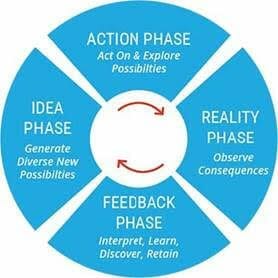
Phase one is the Reality Phase where we turn to observation and seek new insights.

Phase One: The Reality Phase, in which we observe and seek new insights.

David focuses on observation of how he communicates and how Erin receives his communication. Because he is not in “detect-correct” mode, he can note Erin’s reaction to tone, words, body language or directive wording. He sees that certain words elicit a negative physical response and a defensive nature from Erin.

Phase Two: The Feedback Phase, in which we take our new observations to heart.

David evaluates the new information gathered in phase one to try and determine why and how his communication might elicit such responses from Erin.

Phase Three: The Idea Phase, in which new knowledge and insights lead to new ideas or applications.

David formulates a new and different way to communicate with Erin, eliminating certain words and deciding to experiment with others.

Phase Four: The Action Phase, in which we experiment and undergo a period of trial and error.

In their next encounter David utilizes his new approach to see whether Erin’s response is different. This ultimately places him back into the first phase, and the cycle continues.

Over the next several weeks, David continues to utilize the Innovation Cycle in seeking better ways to communicate with Erin. As a result, he finds four specific actions he needs to eliminate and six new ways to communicate that, in turn, helps Erin to open up and communicate on a more effective level.

Now, many will say, “Isn’t that what we all do?” Unfortunately, we don’t fully complete this process as often as we think we do. When “detect-correct” is our primary operational mindset, we utilize what is known. Experimentation is not usually valued at the same level as status quo.

David had to break out of this mindset to open up new possibilities he had not explored before. He had to eliminate the old habits he had developed in working with others, because the methods were not effective with Erin’s thinking style and process.

Innovation is not just about product or idea development. It is a mindset – one that can be changed and developed IF the right environment is provided. Time and effort must be invested in experimentation in order for true innovation to occur.

In this case, a very high performance employee is retained and becomes even more productive. Further, a leader’s stress and frustration is reduced, and he becomes a more effective executive because of his newly developed insights and skills.

If you want better communications at the executive level, we urge you to give the Innovator Cycle a try!

Stay tuned for our next post, when we’ll discuss ways to develop an Innovator culture throughout your company.

For more on the InnovatorMindset® contact H. Goerger & Associates Inc. dba AskHG, one of the first to be certified in the nation.


InnovatorMindset® is the property of Dennis Stauffer, www.InnovatorMindset.com

CEO Solutions Members Make Fast-Growth List

fast growth

Five of CEO Solutions’ member organizations were named to the 2017 Inc. 5000 list of fastest-growing companies, including one in its first year of eligibility. Four of the five companies experiencing this notable fast growth are new, first-generation companies, and all have CEOs under the age of 35.

The highest of the CEO Solutions members on the list is Stoneridge Software, a Barnesville, Minn.-based Microsoft partner that implements Microsoft Dynamics software. According to the InForum, “these products, in turn, help clients modernize their workflow, get access to real-time business intelligence and streamline their operations.”

The company, which was founded just five years ago by three former Microsoft employees, ranked 1,050 overall and 12th in Minnesota after experiencing a 365 percent spike in revenue over the last three years.

The four additional CEO Solutions member organizations on the fast growth list are:

  • Myriad Mobile, based in Fargo, which ranked 1,449 on the list after recording 280 percent growth
  • Laketown Electric, based in Wachovia, which ranked 1,887 after 202 percent growth
  • Thomsen Homes, based in Fargo, which ranked 3,071 after 171 percent growth
  • TrueIT, based in Fargo, which ranked 3,690 after 82 percent growth

As members of the CEO Solutions program, all five of the companies have implemented the EOS Traction management operational system. This simple but effective program focuses on clarity, focus, outcomes, accountability and people growth, creating a basis for profitable, fast growth.

With peer advisory groups meeting regularly in Minneapolis, St. Cloud and Fargo, CEO Solutions is a valuable business development resource for company leaders, whether experienced in their position or new to the job. Not only do our members learn valuable operational skills, but they also receive peer support that helps them perform at their best.

Interested in learning more about CEO Solutions? Attend one of our free executive briefings, to be held on November 1 in St. Cloud and November 15 in Minneapolis. There, you’ll learn about strategies for retaining employees and encouraging growth, with a focus on people and leadership, finance, market and competition.

Get more information and register for the St. Cloud briefing here and the Minneapolis briefing here.

The Innovator Cycle Compared

Innovation: what a word! It’s spoken often, but do we truly understand it, support it and utilize its outcomes?

These are essential questions for executives who are leading companies and looking for that competitive edge. So we use the word innovation quite readily when discussing how to be more competitive, achieve greater market share or drive opportunity.

Based on decades of research, the InnovatorMindset® profile looks at two types of cycles to define true innovation versus what most business leaders actually do.

Most of us tend to adopt the Status Quo Cycle, which has four phases:

  1. Idea Phase: We ask, “How do we reproduce existing possibilities?” We aren’t seeking new or outside information, but simple sustainability of the existing known outcomes. Our focus tends to be on that which is proven, what we already know and have used.
  2. Feedback Phase: We look for reinforcement of what has worked in the past and why it worked. We restore our world to what has been and try to maintain the status quo.
  3. Reality Phase: We detect deviations in the present system or process that could cause a different or lesser outcome. Our focus is then on correction of the deviation to return to the normal or existing.
  4. Action Phase: In this corrective phase, we apply the solutions we are familiar with or have previously used in order to eliminate the deviations and return to the norm.

In the Status Quo Cycle, the focus is on utilizing the known and existing solutions to maintain the existing norm. Often times this referred to as “detect and correct”, which is vital to a sound and functioning business operation. We do not want to eliminate or avoid this cycle, but simply be aware of which cycle we are in.

In comparison, the Innovation Cycle seeks new information and explores what is not yet known, in four phases.

  1. The Reality Phase: We observe our business surroundings and our environment, and become aware of what is or is not happening. We see consequences that might not have been noted before and outcomes that we were not aware of. We look for the new or different versus the known and established.
  2. Feedback Phase: The new information or insight is interpreted. We seek to learn new knowledge, discover various applications and retain that which has possible value.
  3. Idea Phase: The new knowledge and insights lead to new ideas or applications that have not been applied before. We strive for new possibilities that existing knowledge has not given us.
  4. Action Phase: We take action by experimenting and undergoing trial and error. We apply the new knowledge and insights to observe what positive or negative outcomes may occur, testing our new hypothesis. This might be referred to as “failing forward:” testing quickly and adjusting to determine the best new solution or opportunity.

You’ll note a significant difference in mindset between the two cycles. The Status Quo is focused on tried, true processes and knowledge to maintain an existing situation, while the Innovator Cycle is all about seeing the existing differently, actively seeking new information and encouraging experimentation to try something new and different.

So what are we suggesting?

First, in which cycle does your organization invest most of its time and energy? Most are in the Status Quo, and occasionally a few within the organization might utilize the Innovation Cycle. What we recommend, and what highly innovative organizations do, is elevate the Innovation Cycle to a higher status, encouraging it through experimentation and working to stay out of Status Quo cycle.

On the flip side, the Status Quo is important, and while only utilizing the Innovation Cycle might be exciting, it’s not stable enough for long term growth and profitability. Both need to be utilized with purpose.

Are you including innovation as an initiative in your strategic planning? If not, perhaps that is a place to start.

Watch for our next post on utilizing the Innovation Cycle as a leadership communication tool.

For more on the InnovatorMindset® contact H. Goerger & Associates Inc. dba AskHG, one of the first to be certified in the nation.

InnovatorMindset® is the property of Dennis Stauffer, www.InnovatorMindset.com

Unlock Innovation with InnovatorMindset®

In business, we hear the word innovation quite often. Innovation has become a buzzword, used in mission statements, core values and promotional materials to try and differentiate who we are.

But what, really, is innovation? Is it being creative and coming up with a thousand new ideas, an art piece or business opportunity? Or is it much more?

Creativity is a component of innovation, of course. But what truly is innovation, and what does it look like in action?

After a decade of research, Dennis Stauffer can help identify what innovation means to you and your company. With the InnovatorMindset® profile, leaders can discover what forms of innovation they understand and support, and what barriers they have to remove. The great thing is that innovation is not a personality trait, but a mindset which we can alter and change permanently, should we choose to.

So what is true innovation? Based on Dennis’s research, there are four components that support and either drive or block innovation. Interestingly, those that rate above 70 in the individual components tend to provide exponential results, yet only 5% of the population is in this group; a 60 puts you in the top 10 percent!

  1.  Your AWARENESS or reality: How clear and aware are you of business surroundings, changes and opportunities?
  2. Your OPENESS or feedback: How well do you take negative feedback? What do the numbers really say? Do you use feedback to drive innovation?
  3. Your CREATIVITY or ideas: Do you value your own ideas and the ideas of others? How do you act on them?
  4. Your BRAVERY or action phase: Innovation tends to swim upstream. Are you brave and bold enough to take the action?

Each of these can be altered, if you choose to. There are three components in each of the four areas that determine your strengths and barriers when it comes to innovation. Each are changeable.

  1. COGNITIVE: How do you think about knowledge or innovation? Perhaps you think it is important, but something is getting in the way.
  2. VALUE: Which do you put more value on, existing knowledge or discovering new knowledge and understanding?
  3. BEHAVIOR: How do you actually behave when innovation opportunities arise? Do you act or retract?

The great thing is that, if innovation is truly part of an organization’s culture, it can drive profit, performance, competitive edge and market dominance. A tool such as the InnovatorMindset® can be a starting point that leads to an awesome future.

Stay tuned for our next post will be on the two competing cycles: “detect/correct” vs “Innovation Cycle.”

For more on the InnovatorMindset® program, contact H. Goerger & Associates Inc., dba AskHG, one of the first to be certified in the nation.

InnovatorMindset® is the property of Dennis Stauffer. www.InnovatorMindset.com